Selected Publications
Selected Publications
with PDF | Sonja’s CV here | H-index=97; total citations=95,342
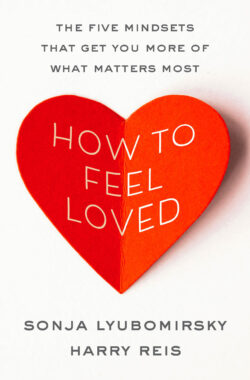
- Lyubomirsky, S., & Reis, H. (2026). How to feel loved: The five mindsets that get you more of what matters most. New York: Harper. Visit the book’s website. Buy the book.
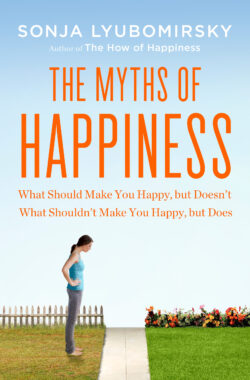
- Lyubomirsky, S. (2013). The myths of happiness: What should make you happy, but doesn’t, what shouldn’t make you happy, but does. New York: Penguin Press. Visit the book’s website. Download the book’s full set of references. See the covers of the book’s translations.
- Lyubomirsky, S. (2022). The myths of happiness. (X, Trans.). Beijing, China: China CITIC Press
- Lyubomirsky, S. (2015). The myths of happiness. (X, Trans.). Taipei, Taiwan: Longstone.
- Lyubomirsky, S. (2015). The myths of happiness. (X, Trans.). Istanbul, Turkey: Kapital.
- Lyubomirsky, S. (2015). The myths of happiness. (X, Trans.). Bangkok, Thailand: Matichon.
- Lyubomirsky, S. (2014). The myths of happiness. (X, Trans.). Tel Aviv, Israel: Kinneret-Zmora.
- Lyubomirsky, S. (2014). Oi mýthoi ti̱s ef̱tychías. (X, Trans.). Athens, Greece: Menandros Editions.
- Lyubomirsky, S. (2014). Os mitos da felicidade: O que deveria fazer você feliz, mas não faz; o que não deveria fazer você feliz, mas faz. (X, Trans.). Rio de Janeiro, Brazil: Odisseia.
- Lyubomirsky, S. (2014). The myths of happiness (X, Trans.). Tokyo, Japan: Nihon Jitsugyo Shuppan.
- Lyubomirsky, S. (2014). Mitai apie laimę. (Margarita Bautrėnienė, Trans). Vilnius, Lithuania: Alma Littera.
- Lyubomirsky, S. (2014). Myterne om lykke. (Henriette Rostrup, Trans).Copenhagen, Denmark: Dansk Psykologisk Forlag.
- Lyubomirsky, S. (2014). Qu’est-ce qui nous rend vraiment heureux? (Laurent Bury, Trans.). Paris: Les Arènes.
- Lyubomirsky, S. (2014). Los mitos de la felicidad (Martín R-Courel Ginzo, Trans.). Barcelona, Spain: Urano.
- Lyubomirsky, S. (2013). The myths of happiness (X, Trans.). Seoul, South Korea: Knowledge Nomad.
- Lyubomirsky, S. (2013). Mity o szczęściu. Warsaw, Poland: Laurum.
- Lyubomirsky, S. (2013). Boldogság-mítoszok: Tények és tévhítek. (X, Trans.). Budapest, Hungary: Ursus Libris.
- Lyubomirsky, S. (2013). Mitovete za schastieto (Nadya Bayeva, Trans.). Sofia, Bulgaria: Obsidian.
- Lyubomirsky, S. (2013). De mythes van geluk: Wetenschappelijke inzichten in wat ons écht gellukkig maakt (Fanneke Cnossen , Trans.). Utrecht, Netherlands: Bruna.
- Lyubomirsky, S. (2013). The myths of happiness: What should make you happy, but doesn’t, what shouldn’t make you hoxforappy, but does (X, Trans.). Beijing, China: Cheers Books.
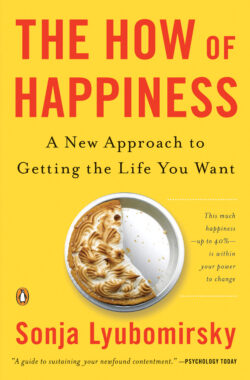
- Lyubomirsky, S. (2008). The how of happiness: A scientific approach to getting the life you want. New York: Penguin Press. Visit the book’s website. Download the book’s references. See the covers of the book’s translations.
- Lyubomirsky, S. (2019). Nasil mutlu olunur? (Gülfer Göze, Trans.). Istanbul, Turkey: Ketebe.
- Lyubomirsky, S. (2014). The how of happiness: 40% (X, Trans.). Beijing, China: China CITIC Press.
- Lyubomirsky, S. (2014). Psichologia schastya (X, Trans.). Saint Petersburg, Russia: Piter.
- Lyubomirsky, S. (2014). The how of happiness (X, Trans.). Taipei, Tawain: Longstone.
- Lyubomirsky, S. (2013). Comment être heureux…et le rester (X, Trans.). Paris: Marabout.
- Lyubomirsky, S. (2011). Como ser feliz: A receita científica para a felicidade (Ana Paula Nereu Reis, Trans.). Lisbon, Portugal: Pergaminho.
- Lyubomirsky, S. (2012). The how of happiness: A new approach to getting the life you want. (X, Trans.).Tokyo: Nihon Jitsugyo Shuppansha. See the covers of the book’s translations.
- Lyubomirsky, S. (2011). The way to happiness: Action plan for a happy life. (Katya Benyovitz, Trans.) Or Yehuda, Israel: Kinneret Publishing House.
- Lyubomirsky, S. (2010). Cum să fii fericit (Dorina Oprea, Trans.). Bucureşti, Romania: Amsta.
- Lyubomirsky, S. (2009). Kuinka onnelliseksi? (Jouni Porio,Trans.). Helsinki, Finland: Basam Books.
- Lyubomirsky, S. (2009). The how of happiness: 40% (X, Trans.). Shanghai, China: East China Normal University Press.
- Lyubomirsky, S. (2009). Ptyat km schastyeto (Teodora Atanasova, Trans.). Sofia, Bulgaria: Knowledge Mont.
- Lyubomirsky, S. (2008). How to be happy (X, Trans.). Seuol, South Korea: Knowledge Nomad.
- Lyubomirsky, S. (2008). Sådan bliver du lykkelig (X, Trans.). Copenhagen, Denmark: Linghardt & Ringhof.
- Lyubomirsky, S. (2008). Wybierz szczescie: Naukowe metody budowania zycia, jakiego pragniesz (X, Trans.).Warsaw, Poland: MT Biznes.
- Lyubomirsky, S. (2008). Nasil mutlu lunur? (Gülfer Göze, Trans.). Istanbul, Turkey: Kapital Medya Hizmetleri A. S.
- Lyubomirsky, S. (2008). A ciência da felicidade: Como atingir a felicidade real e duradoura (Patrícia Sá, Trans.). Rio de Janeiro, Brazil: Elsevier.
- Lyubomirsky, S. (2008). Hogyan legyünk boldogok? Az önmegvalósítás útjai tudományos megközelítésben(Turóczi Attila, Trans.). Budapest, Hungary: Ursus Libris.
- Lyubomirsky, S. (2008). Lyckans verktyg: En vetenskaplig guide till lycka (Johan Nilsson, Trans.). Stockholm: Natur & Kultur.
- Lyubomirsky, S. (2008). Comment être heureux…et le rester (Camille Fort, Trans.). Paris: Flammarion.
- Lyubomirsky, S. (2008). La ciencia de la felicidad (Alejandra Devoto, Trans.). Barcelona, Spain: Urano.
- Lyubomirsky, S. (2008). Glücklich sein: Warum Sie es in der Hand haben, zufrieden zu leben (Jürgen Neubauer, Trans.). Frankfurt, Germany: Campus Verlag.
- Lyubomirsky, S. (2008). De maakbaarheid van het geluk (Frans van Delft, Trans.). Amsterdam: Archipel.
- Lyubomirsky, S. (2010). The how of happiness: A practical approach to getting the life you want. London: Piatkus.
- Lyubomirsky, S., & Layous, K. (2025). Well-being. In D.T. Gilbert, S. T. Fiske, E. . Finkel, & W. B. Mendes (Eds.), The handbook of social psychology (6th). Situational Press. https://doi.org/10.70400/UKJM3949
- Reis, H. T., Regan, A., & Lyubomirsky, S. (2021). Interpersonal chemistry: What is it, how does it emerge, and how does it operate? Perspectives on Psychological Science, 17(2), 530-558.
- Martinez, R. L., Lyubomirsky, S., & Cole, S. W. (2026). An extraverted behavior intervention improves gene expression. Brain, Behavior, & Immunity, 134. https://doi.org/10.1016/j.bbi.2026.106299
- Lyubomirsky, S. (2022). Toward a new science of psychedelic social psychology: The effects of MDMA (ecstasy) on social connection. Perspectives on Psychological Science. Watch overview of this paper in this 15-min talk.
- Molla, H., Lee, R., Lyubomirsky, S., & de Wit, H. (2023). Drug-induced social connection: Both MDMA and methamphetamine increase feelings of connectedness during controlled dyadic conversations. Scientific Reports, 13, 15846.
- Martinez, R. L., Radošić, N., Molla, H., de Wit, H., & Lyubomirsky, S. (2025). The empathogen 3,4-methylenedioxymethamphetamine, but not methamphetamine, increases feelings of global trust. Journal of Psychopharmacology. https://doi.org/10.1177/02698811251370999
- Regan, A., Margolis, S., de Wit, H., & Lyubomirsky, S. (2021). Does ±3,4-methylenedioxymethamphetamine (ecstasy) induce subjective feelings of social connection in humans? A multilevel meta-analysis. PLoS ONE, 16(10): e0258849.
- Nelson-Coffey, S. K., Fritz, M. M., Lyubomirsky, S., & Cole, S. W. (2017). Kindness in the blood: The gene regulatory impact of prosocial behavior. Psychoneuroendocrinology, 81, 8-13. Supplemental Materials here.
- Margolis, S., & Lyubomirsky, S. (2020). Experimental manipulation of extraverted and introverted behavior and its effects on well-being. Journal of Experimental Psychology: General, 149(4), 719-731.
- Regan, A., Radošic, N., & Lyubomirsky, S. (2022). Experimental effects of social behavior on well-being. Trends in Cognitive Sciences, 26(11), 987-998.
- Walsh, L. C., Regan, A., & Lyubomirsky, S. (2022). The role of actors, targets, and witnesses: Examining gratitude exchanges in a social context. The Journal of Positive Psychology, 17(2), 233-249. Supplemental Materials here.
- Fritz, M. M., Margolis, S., Radošić, N., Revord, J. C., Rosen Kellerman, G. R., Nieminen, L. R. G., Reece, A., & Lyubomirsky, S. (2023). Examining the social in the prosocial: Episode-level features of social interactions and kind acts predict social connection and well-being. Emotion, 23(8), 2270-2285. See Nina Radošić’s post on this paper in Character & Context.
- Martinez, R. L.,Vannoy, T. K., & Lyubomirsky, S. (2026). Self-administered positive activity interventions. In L. Tay & B. M. McCuskey (Eds.), The Oxford handbook of well-being in higher education (pp. 205-217). Oxford University Press.
- Martinez, R. L., Regan, A., & Lyubomirsky, S. (2026). Pathways to self-compassion: The effects of self-kind behaviors and self-kind thoughts on self-compassion and well-being. Affective Science.
- Cadieux, S., & Lyubomirsky, S. (2026). How chanting enhances well-being: The roles of vocalization, repetition, and concentration. Mindfulness. https://doi.org/10.1007/s12671-026-02951-2
- Margolis, S., Elder, J., Chinn, J., Hughes, B., & Lyubomirsky, S. (in press). What are the most important predictors of subjective well-being? Insights from machine learning and linear regression approaches on the MIDUS datasets. In Dunn, D. (Ed.), Positive psychology: Established & emerging issues (2nd ed., pp. 90-113).
- Okabe-Miyamoto, K., Walsh, L. C., Ozer, D. J., & Lyubomirsky, S. (2024). Measuring the experience of social connection within specific social interactions: The Connection During Conversations Scale (CDCS). PLoS ONE, 19(1), e0286408. Download our new Connection During Conversations Scale.
- Walsh, L. C., Regan, A., Okabe-Miyamoto, K., & Lyubomirsky, S. (2024). Does putting away your smartphone make you happier? The effects of restricting digital media and social media on well-being. PLOS ONE, 19(10), e0306910. Download Supplemental Materials here.
- Vannoy, T. K., Walsh, L. C., Liao, L., & Lyubomirsky, S. (2026). Individual differences in the affective experience of writing a gratitude letter: Who benefits most? Behavioral Sciences, 16, 232.
- Vannoy, T. K., Cadieux, S., & Lyubomirsky, S. (in press). Human 2.0? AI and the future of well-being and personal growth: A narrative review. Behavioral Sciences.
- Margolis, S., Elder, J., Chinn, J., Hughes, B., & Lyubomirsky, S. (in press). What are the most important predictors of subjective well-being? Insights from machine learning and linear regression approaches on the MIDUS datasets. In Dunn, D. (Ed.), Positive psychology: Established & emerging issues (2nd ed., pp. 90-113).
- Martinez, R. L., Regan, A., Okabe-Miyamoto, K., & Lyubomirsky, S. (2025). Only the lonely: Learning, use of skills, and sense of meaning buffer the costs of reduced social connection for life satisfaction. The Journal of Positive Psychology.
- Okabe-Miyamoto, K., Folk, D., Lyubomirsky, S., & Dunn, E.W. (2021). Changes in social connection during COVID-19 social distancing: It’s not (household) size that matters, it’s who you’re with. PLoS ONE, 16(1), e0245009.
- Folk, D., Okabe-Miyamoto, K., Dunn, E.W., & Lyubomirsky, S. (2020). Did social connection declined during the first wave of COVID-19?: The role of extraversion. Collabra: Psychology, 6(1), 37.
- Regan, A., Margolis, S., Ozer, D.J.. Schwitzgebel, E., & Lyubomirsky, S. (2023). What is unique about kindness? Exploring the proximal experience of prosocial acts relative to other positive behaviors. Affective Science, 4, 92-100.
- Regan, A., Walsh, L. C., & Lyubomirsky, S. (2023). Are some ways of expressing gratitude more beneficial than others? Results from a randomized controlled experiment. Affective Science, 4, 72-81.
- Walsh, L. C., Regan, A., Twenge, J. M., & Lyubomirsky, S. (2023). What is the optimal way to give thanks? Comparing the effects of gratitude expressed privately, one-to-one via text, or publicly on social media. Affective Science, 4, 82-91.
- Gladstone, J. J., Ruberton, P. M., Margolis, S., & Lyubomirsky, S. (2024). Does variety in hedonic spending improve happiness? Testing alternative causal mechanisms between hedonic variety and subjective well-being. BMC Psychology, 12: 98.
- Margolis, S., Schwitzgebel, E., Ozer, D. J., Martinez, R., & Lyubomirsky, S. (2022).Measuring eudaimonic and non-eudaimonic goods in the pursuit of the good life: The Riverside Eudaimonia Scale and the Rich & Sexy Well-Being Scale. International Journal of Well-Being, 12(1), 1-20. Download Supplemental Materials here.
- Okabe-Miyamoto, K., Margolis, S., & Lyubomirsky, S. (2023). Is variety the spice of happiness? More variety is associated with lower efficacy of positive activity interventions in a sample of over 200,000 happiness seekers. The Journal of Positive Psychology.
- Walsh, L. C., Montemayor-Dominguez, M., Horton, C., Boz, S. G., & Lyubomirsky, S. (in press). Worker well-being: A continuous improvement framework. Applied Research in Quality of Life.
- Okabe-Miyamoto, K., & Lyubomirsky, S. (2024). Happiness shapes and is shaped by social cognition and social connection. In D. Carlston, K. Johnson, & K. Hugenberg (Eds.), The Oxford handbook of social cognition (2nd ed., pp. 721-739). Oxford University Press.
- Moran, L., Shiferahu, R., Tay, L., & Lyubomirsky, S. (in press). A framework for intergrating AI conversational agents into positive psychology interventions. The Journal of Positive Psychology.
- Elmer, T., Vannoy, T. K., Studerus, E., Lyubomirsky, S. (2024). Subjective long‐term emotional and social effects of recreational MDMA use: The role of setting and intentions. Scientific Reports, 14, 3434. https://doi.org/10.1038/s41598-024-51355-6
- Vannoy, T. K., & Lyubomirsky, S. (2024). Psychedelic social psychology and wellbeing. In J. E. Maddux (Ed.), Subjective well-being and life satisfaction (2nd ed., pp. 78-102). Routledge. https://doi.org/10.4324/9781003393368 .
- Aknin, L. B., De Neve, J-E., Dunn, E. W., Fancourt, D. E., Goldberg, E., Helliwell, J. F., Jones, S. P., Karam, E., Layard, R., Lyubomirsky, S., Rzepa, A., Saxena, S., Thornton, E. M., VanderWeele, T. J., Whillans, A. V., Zaki, J., Caman, O. K., & Ben Amor, Y. (2022). Mental health during the first year of the COVID-19 pandemic: A review and recommendations for moving forward. Perspectives on Psychological Science, 17(4), 915-936. Listen to the audio narration of this article (by Liz Dunn) here!
- Fritz, M. M., Walsh, L. C., Cole, S. W., Epel, E., & Lyubomirsky, S. (2020). Kindness and cellular aging: A pre-registered experiment testing the effects of prosocial behavior on telomere length and well-being. Brain, Behavior, & Immunity – Health, 11: 100287.
- Regan, A., Fritz, M. M., Walsh, L. C., Lyubomirsky, S., & Cole, S. W. (2022). The genomic impact of kindness to self vs. others: A randomized controlled trial. Brain, Behavior, and Immunity, 106, 40-48.
- Regan, A., & Lyubomirsky, S. (2022). Inducing sociability: Insights from well-being science. In J. P. Forgas, W. Crano, & K. Fiedler (Eds.), The psychology of sociability: Understanding human attachment (pp. 79-97). Routledge.
- Shin, L. J., Margolis, S. M., Walsh, L. C., Kwok, S. Y., Yue, X., Chan, C-K., Siu, N. Y-F., Sheldon, K. M., & Lyubomirsky, S. (2021). Cultural differences in the hedonic rewards of recalling kindness: Priming cultural identity with language. Affective Science, 2(1), 80-90.
- Sheldon, K. M., & Lyubomirsky, S. (2021). Revisiting the Sustainable Happiness Model and pie chart: Can happiness be successfully pursued? The Journal of Positive Psychology, 16(2), 145-154.
- Armenta, C. N., Fritz, M. M., Walsh, L. C., & Lyubomirsky, S. (2022). Satisfied yet striving: Gratitude promotes life satisfaction and improvement motivation in youth. Emotion, 22(5), 1004-1016.
- Walsh, L. C., Armenta, C. N., Itzchakov, G., Fritz, M. M., & Lyubomirsky, S. (2022). More than merely positive: The immediate affective and motivational consequences of gratitude. Sustainability, 14, 8679.
- Layous, K., Sweeny, K., Armenta, C., Na, S., Choi, I., & Lyubomirsky, S. (2017). The proximal experience of gratitude. PLoS ONE, 12(7): e0179123.
- Nelson, S. K., Ruberton, P. M., Chancellor, J., Cornick, J., Blascovich, J., & Lyubomirsky, S. (2019). The proximal experience of awe. PLoS ONE, 14(5), e0216780.
- Margolis, S., Stapley, A. L., & Lyubomirsky, S. (2019). The association between extraversion and well-being is limited to one facet. Journal of Personality, 88, 478-484.
- Kubzansky, L. D., Kim, E. W., Boehm, J. K., Davidson, R. J., Huffman, J. C., Loucks, E. G., Lyubomirsky, S., Picard, R., Schueller, S. M., Trudel-Fitzgerald, C. VanderWeele, T. J., Warran, K., Yeager, D. S., Yeh, C. S., & Moskowitz, J. T. (2023). Interventions to modify psychological well-being: What works, what doesn’t work, and an agenda for future research. Affective Science, 4, 174-184.
- Revord, J., Sweeny, K., & Lyubomirsky, S. (2021). Categorizing the function of positive emotions. Current Opinion in Behavioral Sciences, 39, 93-97.
- Fritz, M. M., Armenta, C. N., Walsh, L. C., & Lyubomirsky, S. (2019). Gratitude facilitates healthy eating behavior in adolescents and young adults. Journal of Experimental Social Psychology, 81, 4-14.
- Aknin, L., De Neve, J-E., Dunn, E., Fancourt, D., Goldberg, E., Helliwell, J., Jones, S., Karam, E., Layard, R., Lyubomirsky, S., Rzepa, A., Saxena, S., Thornton, E., VanderWeele, T., Whillans, A., Zaki, J., Caman, O. K., & Ben Amor, Y. (2021). The neurological consequences of contracting COVID-19. Acta Psychologica, 19(3), 301-305.
- Parnia, S., Post, S., Lee, M., Lyubomirsky, S., Aufderheide, T., Greyson, B., Long, J., Gonzales, A., Hyppert, E., Dickinson, A., Fricchione, G., Mayer, S., Locicero, B., Levin, J., Bossis, J., Worthington, E., Fenwick, P, & Keshavarz Shirazi, T. (2022). Guidelines and standards for the study of death and recalled experiences of death-A multidisciplinary consensus statement and proposed future directions. Annals of the New York Academy of Sciences. Supplement S1. Supplement S2.
- Walsh, L. C., Boehm, J. K., & Lyubomirsky, S. (2018). Does happiness promote career success? Revisiting the evidence. Journal of Career Assessment, 26, 199-219.
- Armenta, C. N., Fritz, M., & Lyubomirsky, S. (2017). Functions of positive emotions: Gratitude as a motivator of self-improvement and positive change. Emotion Review, 9, 183-190.
- Boehm, J. K., Ruberton, P. M., & Lyubomirsky, S. (2017). The promise of fostering greater happiness. In C. R. Snyder, S. J. Lopez, L. M. Edwards, L., & S. C. Marques (Eds.), Oxford handbook of positive psychology (3rd ed., pp. 945-958). Oxford University Press.
- Nelson, S. K., Layous, K., Cole, S., & Lyubomirsky, S. (2016). Do unto others or treat yourself?: The effects of prosocial and self-focused behavior on psychological flourishing. Emotion, 16, 850-861.
- Nelson, S. K., Kushlev, K., & Lyubomirsky, S. (2014). The pains and pleasures of parenting: When, why, and how is parenthood associated with more or less well-being? Psychological Bulletin, 140, 846-895.
- Nelson, S. K., Kushlev, K., English, T., Dunn, E. W., & Lyubomirsky, S. (2013). In defense of parenthood: Children are associated with more joy than misery. Psychological Science, 24, 3-10.
- Lyubomirsky, S., & Layous, K. (2013). How do simple positive activities increase well-being? Current Directions in Psychological Science, 22, 57-62.
- Layous, K., Lee, H., Choi, I., & Lyubomirsky, S. (2013). Culture matters when designing a successful happiness-increasing activity: A comparison of the United States and South Korea. Journal of Cross-Cultural Psychology, 44, 1294-1303.
- Layous, K., Nelson, S. K., & Lyubomirsky, S. (2013). What is the optimal way to deliver a positive activity intervention? The case of writing about one’s best possible selves. Journal of Happiness Studies, 14, 635-654.
- Layous, K., Nelson, S. K., Oberle, E., Schonert-Reichl, K., & Lyubomirsky, S. (2012). Kindness counts: Prompting prosocial behavior in preadolescents boosts peer acceptance and well-being. PLOS ONE, 7, e51380.
- Sheldon, K. M., & Lyubomirsky, S. (2012). The challenge of staying happier: Testing the Hedonic Adaptation Prevention model. Personality and Social Psychology Bulletin, 38, 670-680.
- Lyubomirsky, S., Dickerhoof, R., Boehm, J. K., & Sheldon, K. M. (2011). Becoming happier takes both a will and a proper way: An experimental longitudinal intervention to boost well-being. Emotion, 11, 391-402.
- Boehm, J. K., Lyubomirsky, S., & Sheldon, K. M. (2011). A longitudinal experimental study comparing the effectiveness of happiness-enhancing strategies in Anglo Americans and Asian Americans. Cognition & Emotion, 25, 1263-1272.
- Sin, N. L., & Lyubomirsky, S. (2009). Enhancing well-being and alleviating depressive symptoms with positive psychology interventions: A practice-friendly meta-analysis. Journal of Clinical Psychology: In Session, 65, 467-487.
- Nolen-Hoeksema, S., Wisco, B. E., & Lyubomirsky, S. (2008). Rethinking rumination. Perspectives on Psychological Science, 3, 400-424.
- Boehm, J. K., & Lyubomirsky, S. (2008). Does happiness promote career success? Journal of Career Assessment, 16, 101-116.
- Howell, R. T., Kern, M. L., & Lyubomirsky, S. (2007). Health benefits: Meta-analytically determining the impact of well-being on objective health outcomes. Health Psychology Review, 1, 83-136
- Lyubomirsky, S., Sousa, L., & Dickerhoof, R. (2006). The costs and benefits of writing, talking, and thinking about life’s triumphs and defeats. Journal of Personality and Social Psychology, 90, 692-708.
- Sheldon, K. M., & Lyubomirsky, S. (2006a). How to increase and sustain positive emotion: The effects of expressing gratitude and visualizing best possible selves. The Journal of Positive Psychology, 1, 73-82.
- Sheldon, K. M., & Lyubomirsky, S. (2006b). Achieving sustainable gains in happiness: Change your actions, not your circumstances. Journal of Happiness Studies, 7, 55-86.
- Lyubomirsky, S., Tkach, C., & DiMatteo, M. R. (2006). What are the differences between happiness and self-esteem? Social Indicators Research, 78, 363-404.
- Tkach, C., & Lyubomirsky, S. (2006). How do people pursue happiness? Relating personality, happiness-increasing strategies, and well-being. Journal of Happiness Studies, 7, 183-225.
- Lyubomirsky, S., King, L. A., & Diener, E. (2005). The benefits of frequent positive affect: Does happiness lead to success? Psychological Bulletin, 131, 803-855.
- Lyubomirsky, S., Sheldon, K. M., & Schkade, D. (2005). Pursuing happiness: The architecture of sustainable change. Review of General Psychology, 9, 111-131.
- Lyubomirsky, S., Kasri, F., & Zehm, K. (2003). Dysphoric rumination impairs concentration on academic tasks. Cognitive Therapy and Research, 27, 309-330.
- Ward, A. H., Lyubomirsky, S., Sousa, L., & Nolen-Hoeksema, S. (2003). Can’t quite commit: Rumination and uncertainty. Personality and Social Psychology Bulletin, 29, 96-107.
- Schwartz, B., Ward, A. H., Monterosso, J., Lyubomirsky, S., White, K., & Lehman, D. (2002). Maximizing versus satisficing: Happiness is a matter of choice. Journal of Personality and Social Psychology, 83, 1178-1197.
- Lyubomirsky, S. (2001). Why are some people happier than others?: The role of cognitive and motivational processes in well-being. American Psychologist, 56, 239-249.
- Lyubomirsky, S., Tucker, K. L., Caldwell, N. D., & Berg, K. (1999). Why ruminators are poor problem solvers: Clues from the phenomenology of dysphoric rumination. Journal of Personality and Social Psychology, 77, 1041-1060.
- Lyubomirsky, S., & Lepper, H. S. (1999). A measure of subjective happiness: Preliminary reliability and construct validation. Social Indicators Research, 46, 137-155.
- Lyubomirsky, S., Caldwell, N. D., & Nolen-Hoeksema, S. (1998). Effects of ruminative and distracting responses to depressed mood on the retrieval of autobiographical memories. Journal of Personality and Social Psychology, 75, 166-177.
- Lyubomirsky, S., & Tucker, K. L. (1998). Implications of individual differences in subjective happiness for perceiving, interpreting, and thinking about life events. Motivation and Emotion, 22, 155-186.
- Lyubomirsky, S., & Ross, L. (1997). Hedonic consequences of social comparison: A contrast of happy and unhappy people. Journal of Personality and Social Psychology, 73, 1141-1157.
- Lyubomirsky, S., & Nolen-Hoeksema, S. (1995). Effects of self-focused rumination on negative thinking and interpersonal problem solving. Journal of Personality and Social Psychology, 69, 176-190.
- Lyubomirsky, S., & Nolen-Hoeksema, S. (1993). Self-perpetuating properties of dysphoric rumination. Journal of Personality and Social Psychology, 65, 339-349.
- Layous, K., & Lyubomirsky, S. (2014). The how, why, what, when, and who of happiness: Mechanisms underlying the success of positive interventions. In J. Gruber & J. T. Moscowitz (Eds.), Positive emotion: Integrating the light sides and dark sides (pp. 473-495). Oxford University Press.
- Lyubomirsky, S. (2010). Hedonic adaptation to positive and negative experiences. In S. Folkman (Ed.), The Oxford handbook of stress, health, and coping (pp. 200-224). Oxford University Press.
- Sheldon, K. M., Boehm, J. K., & Lyubomirsky, S. (2012). Variety is the spice of happiness: The hedonic adaptation prevention (HAP) model. In I. Boniwell & S. David (Eds.), Oxford handbook of happiness (pp. 901-914). Oxford University Press.
- Sheldon, K. M., & Lyubomirsky, S. (2004). Achieving sustainable new happiness: Prospects, practices, and prescriptions. In A. Linley, & S. Joseph (Eds.), Positive psychology in practice (pp. 127-145). John Wiley & Sons.
- Lyubomirsky, S., & Tkach, C. (2004). The consequences of dysphoric rumination. In C. Papageorgiou & A. Wells (Eds.), Rumination: Nature, theory, and treatment of negative thinking in depression (pp. 21-41). John Wiley & Sons.

Under Review
Under Review
- Schöne, J. P., Salecha, A., Lyubomirsky, S., Eichstaedt, J. C., & Willer, R. (2026). Structured AI dialogues can increase happiness and meaning in life. Manuscript under review.
- Szaszi, B., Dunn, E., Folk, D., Clelland, H. T., Maier, M., Szecsi, P., Singmann, H., Kovacs, M., Takayanagi, J. F. G. B., Maheshka, C., Lyubomirsky, S., Whillans, A., Sun, J., Aknin, L. B., Oishi, S., Pressman, S. D., Lucas, R., White, M. P., Sparacio, A., . . . Coles, N. A. (2026). A global megastudy of the effectiveness of popular activities for promoting happiness [Stage 1 Registered Report, unpublished manuscript]. Zenodo. https://doi.org/10.5281/zenodo.22788118
- Walsh, L. C., Okabe-Miyamoto, K., Regan, A., Twenge, J. M., & Lyubomirsky, S. (2025). The association between well-being and objectively measured versus self-reported smartphone time. Manuscript under review.
- Molla, H., Smadi, S., Lyubomirsky, S., Li, T., & de Wit, H. (2024). Deconstructing dialogue: What drives feelings of connectedness in conversations? Manuscript under review.
- Radošić, N., Collier, E., Reece, A., Martinez, R., Regan, A., & Lyubomirsky, S. (2024). What happens after a brief online conversation with a stranger? Effects of two conversation formats on mood, subjective perceptions, and objective conversational behaviors. Manuscript under review. [Abstract. Email for copy.]
- Blades, R. B., Guevarra, D. A., Xu, X. O., Wang, W. K., Callahan, P., Smith, J., Simon-Thomas, E., Lyubomirsky, S., & Epel, E. S. (2026). What sparks joy? A comparison of seven daily positive psychology micro-acts. Manuscript under review.
Op-Eds/Popular Press
Op-Eds/Popular Press
- Lyubomirsky, S. (2026, September). Say cheese! Why does smiling make you happy? Highlights Magazine.
- Reis, H. T., Lyubomirsky, S., & Lewis, K. R. (2026, February 10). Five ways to feel more loved. Greater Good Magazine.
- Lyubomirsky, S. (2025, January 10). The science of positive activities: How to maximize happiness and avoid pitfalls. Inner Body.
- Lyubomirsky, S. (2023, June 12). Everything everywhere all at once. In E. Horvitz (ed.), AI Anthology.
- Dunn, E., & Lyubomirsky, S. (2020, May 5). Extraverts are faring surprisingly well in lockdown. Washington Post.
- Lyubomirsky, S. (2020, March 31). 10 positivity boosting tips for musicians. Record Union.
- Lyubomirsky, S. & Fritz, M. M. (2019, July 5). How to be happier. Character & Context.
- Walsh, L. C., Boehm, J. K.. & Lyubomirsky, S. (2019, May 24). Happiness doesn’t follow success: It’s the other way around. Aeon Magazine.
- Fritz, M. M., & Lyubomirsky, S. (2018, March 20). How and why positive activities can make you happier. Behavioral Scientist.
- Fritz, M. M., & Lyubomirsky, S. (2018, March 27). The happiness boomerang effect: When positive activities backfire. Behavioral Scientist.
- Walsh, L. C., Boehm, J. K., & Lyubomirsky, S. (2018, August 13). Is happiness a consequence or cause of career success? LSE Business Review.
- Armenta, C. N., & Lyubomirsky, S. (2017, May 23). How gratitude motivates us to become better people. Greater Good: The Science of a Meaningful Life.
- Revord, J., & Lyubomirsky, S. (2017, October 4). How to be happy: A psychologists view of #HEhappiness. Times Higher Education.
- Lyubomirsky, S. (2015, July 2). Pursue happiness, but in moderation. New York Times, Room for Debate, The Opinion Pages.
- Lyubomirsky, S. (2015, November 5). Will an optimist or a pessimist win in 2016? Los Angeles Times, A19.
- Diener, E., Pressman, S. D., & Lyubomirsky, S. (2015, December 17). Can 1 million women be wrong about happiness and health? Los Angeles Times, A21.
- Lyubomirsky, S. (2015, April 16). The science of coming alive. Huffington Post.
- Lyubomirsky, S. (2012, December 23). Fantasy vs. reality. New York Times, Room for Debate, The Opinion Pages.
- Lyubomirsky, S. (2013, August 1). Do children bring happiness — or misery? TIME.
- Yano, K., Lyubomirsky, S., & Chancellor, J. (2012). Sensing happiness. IEEE Spectrum, 40, 26-31.
- Lyubomirsky, S. (2012, December 2). New love: A short shelf life. New York Times, SR1.
- Lyubomirsky, S., & Jacobs, K. M. (2010). Comment construire un bonheur durable. [How to build lasting happiness.] Cerveau & Psycho: Le magazine de la psychologie et des neurosciences, 37, 62-64.
- Lyubomirsky, S. (2011, July 7). The Longevity Project. [Review of the book The Longevity Project.] Nature, 475, 32.
- Lyubomirsky, S. (2010, December). Become happier. Personal Excellence, 7.
- Lyubomirsky, S. (2010, August 10). Can money buy happiness? New research reveals that reminders of wealth impair our capacity to savor life’s little pleasures. Scientific American.
- Lyubomirsky, S. (2009, July 14). What if I’d never met my husband: New research reveals a better way to boost happiness than counting blessings — imagining that the good things never happened. Scientific American.
- Lyubomirsky, S. (2008, December 27). Why we’re still happy. New York Times, A25.
- Lyubomirsky, S. (2008, December 27). Happy, despite it all: How a new outlook can help us cope — even thrive — in adversity. Riverside Press-Enterprise, E1, E4.
- Lyubomirsky, S. (2008, July 5). Smiles give leadership clues. Riverside Press-Enterprise.
- Lyubomirsky, S. (2008). Happiness. In G. Stone (Ed.), The 12-step Bush recovery program (pp. 118-120). New York: Villard.
- Lyubomirsky, S. (2008, January). Work may hold the key to your happiness. Harvard Community Resource, XVII, 3.
- Lyubomirsky, S. (2006b). Is it possible to become lastingly happier? Lessons from the modern science of well-being. In Vancouver Dialogues(pp. 53-56). Vancouver: Truffle Tree Publishing.
- Lyubomirsky, S. (2005, January 17). Eight steps toward a more satisfying life. Time, 165, A8-A9. Pg 1 Pg 2
Subjective Happiness Scale
Subjective Happiness Scale
(permission granted for all non-commercial use)
- Please cite the following paper in all work using the scale: Lyubomirsky, S., & Lepper, H. (1999). A measure of subjective happiness: Preliminary reliability and construct validation. Social Indicators Research, 46, 137-155. The original publication is available at www.springerlink.com.
- The Subjective Happiness Scale (SHS) can be used for non-commercial (nonprofit) purposes, including scholarly/academic.
- Please contact Sonja Lyubomirsky (sonja.lyubomirsky[at]ucr.edu) to obtain a translated version or to send her your own translation. The following languages are currently available: Bulgarian, Chinese, Croatian, Danish, Dutch, Estonian, Filipino, Finnish, French, German, Greek, Gujarati, Hebrew, Hungarian, Indonesian, Italian, Japanese, Korean, Malay, Norwegian, Persian, Peruvian, Polish, Portuguese, Romanian, Russian, Scandinavian, Serbian, Sinhala, Slovak, Spanish (European), Spanish (Mexican), Swedish, Tamil, Thai, Turkish, Urdu
- To score the scale, reverse code the 4th item (i.e., turn a 7 into a 1, a 6 into a 2, a 5 into a 3, a 3 into a 5, a 2 into a 6, and a 1 into a 7), and compute the mean of the 4 items. Norms are available in the reference below, as well as in many other publications that have used the scale (see PsycInfo). Important Note: We now recommend omitting the 4th item and only using the first three items.
- Download a copy of the SHS here.